
The Right Backend for the Right Problem

Barox
Software Engineer
Key Takeaways
- The instinct to put expensive work on the server is worth arguing against specifically for stateless, compute-heavy tasks like image generation — not as a blanket case against backends.
- A recurring manual task, not a client request, was the actual reason to rebuild for self-serve multi-tenancy instead of shipping another one-off campaign site.
- Postgres Row Level Security enforces per-tenant data isolation at the database layer, so isolation doesn't depend on application code getting every check right.
- Cloudflare's own analytics were the trusted source for traffic and cost claims here, since PostHog and GA4 both undercounted visits significantly during the campaign.
- A week-long campaign with over 67,000 visits stayed entirely inside Cloudflare R2's free tier for storage and request volume.
"Put the expensive part on the server, that's what backends are for." That's the instinct I followed the first time I built this site — and it's the specific instinct I want to argue against here, not backend architecture in general. The second version I built genuinely needed a real backend — Postgres, auth, row-level security — for a problem the first version never had. What stayed constant across both versions is where the actual expensive work happens, and that's the decision worth arguing about.
The product itself is simple: trian.barox.dev, a site where a đoàn viên — a member of Vietnam's Youth Union — picks a frame, writes a short tribute message, and submits it. This round was built for Vĩnh Long's provincial Youth Union (tỉnh đoàn), around the 79th anniversary of War Invalids and Martyrs Day (27/7), Vietnam's yearly day of remembrance for fallen and wounded soldiers. None of that context changes the architecture much. What matters is that I built this twice, three years apart, and the two versions disagree with each other on almost every technical decision except one.
The first version, and the constraints that actually mattered
Three or four years ago, there were exactly two constraints worth naming: no budget for infrastructure, and end users — Youth Union staff — who weren't technical. I ignored both, at first. I built the way I'd been trained to build: a proper backend, a proper frontend, image generation handled server-side because that's where "real" apps do it.
It didn't survive contact with the actual job. Server-side image generation meant paying for compute for an event that runs a few days a year. Deployment got more complicated than a five-province rollout justified. The backend I built to look professional was working against the constraints in front of me, not for them.
What client-side bought me
So I dropped it. The tribute image gets generated on the visitor's own device — the server never touches the expensive part. Storage went to Firestore, the one real recurring cost in the whole stack. For a database, I used a Google Sheet, not as a stopgap but as the actual right call: Youth Union staff could open it, filter it, edit it themselves, with zero dashboard for me to build or maintain. I put a REST layer in front of it with sheet.best — full CRUD, JSON, indistinguishable from a real API to the rest of the app — and later swapped that layer for n8n once request volume outgrew sheet.best's limits.
That version shipped to five provincial Youth Unions — Phú Nhuận, Ho Chi Minh City, Bến Tre, Vĩnh Long, Tây Ninh — one deployment per event. Then it sat untouched for a year or two. Nobody asked for more. Neither did I.
The second version wasn't a client request
Here's an assumption worth heading off: that Vĩnh Long came back asking for a self-serve platform. They didn't. They asked for the same thing as before — build them a new one, this time for the 79th anniversary of 27/7. Self-serve was my call, not theirs.
The reason was a problem I'd been quietly eating for years: every "new one" meant hand-positioning the x/y coordinates of a name, a title, and a message on a template, per campaign, by hand, every single time. It never scaled, and Vĩnh Long's return was just the occasion that made fixing the root cause worth the time.
Rebuilding for multi-tenant, not for a bigger MVP
Fixing that meant a real rebuild, not a patch — and this time, a real backend was the right call, not the wrong instinct. Frontend moved to TanStack Start, an SSR framework, because the app now needed real routing and server rendering, not a single-page app pretending to be one. The bigger change was the backend: Firestore and the Google Sheet hack couldn't carry what self-serve actually requires. Postgres, via Supabase, took over storage and auth.
Self-serve for one province is a form. Self-serve for province after province, without any of them touching SQL or seeing each other's data, is a different problem — and it's the one actually worth describing here. Every campaign lives in one shared table, tagged with an owner_id tied to a Supabase auth user. Isolation isn't app-code logic a bug could bypass; it's Postgres Row Level Security enforced at the database layer — an owner can see and create only their own rows, regardless of what the frontend does or forgets to check. Campaign slugs are public URLs and have to stay unique platform-wide, so a security-definer function checks availability without exposing any other province's data to do it. Every campaign also carries a status — pending, approved, rejected, suspended — so nothing goes live before someone signs off on it.
Notice what didn't change, though: image generation is still entirely client-side. The backend grew because multi-tenant data isolation demanded it, not because the expensive part moved onto a server. That's the actual argument — not "avoid backends," but "add exactly the backend the new problem requires, and not an inch more."
The rest of the stack is more straightforward:
- Image uploads go through Supabase Edge Functions issuing presigned URLs; the files themselves live in Cloudflare R2.
- The layout editor — the actual fix for the x/y problem — is a drag-and-drop, Konva-based canvas.
- The submission flow still generates and downloads the tribute image client-side; a visitor's raw avatar photo gets composited into the frame before upload and is never stored on its own.
- PostHog and GA4 run side by side for analytics — both wired up by Claude directly, in a branch named for the task, not just advised on.
- Rollbar handles error monitoring. Cloudflare Turnstile guards the public submission form against bots.
One thing I'm not going to overstate: the architecture is genuinely multi-tenant, but so far exactly one province has used it that way. Nearly all of this campaign's traffic comes from a single owner. This was built for scale I don't have yet, not scale I'm already running — and I'd rather say that plainly than let the multi-tenant design imply an adoption story that hasn't happened.
The numbers, and which source I actually trust
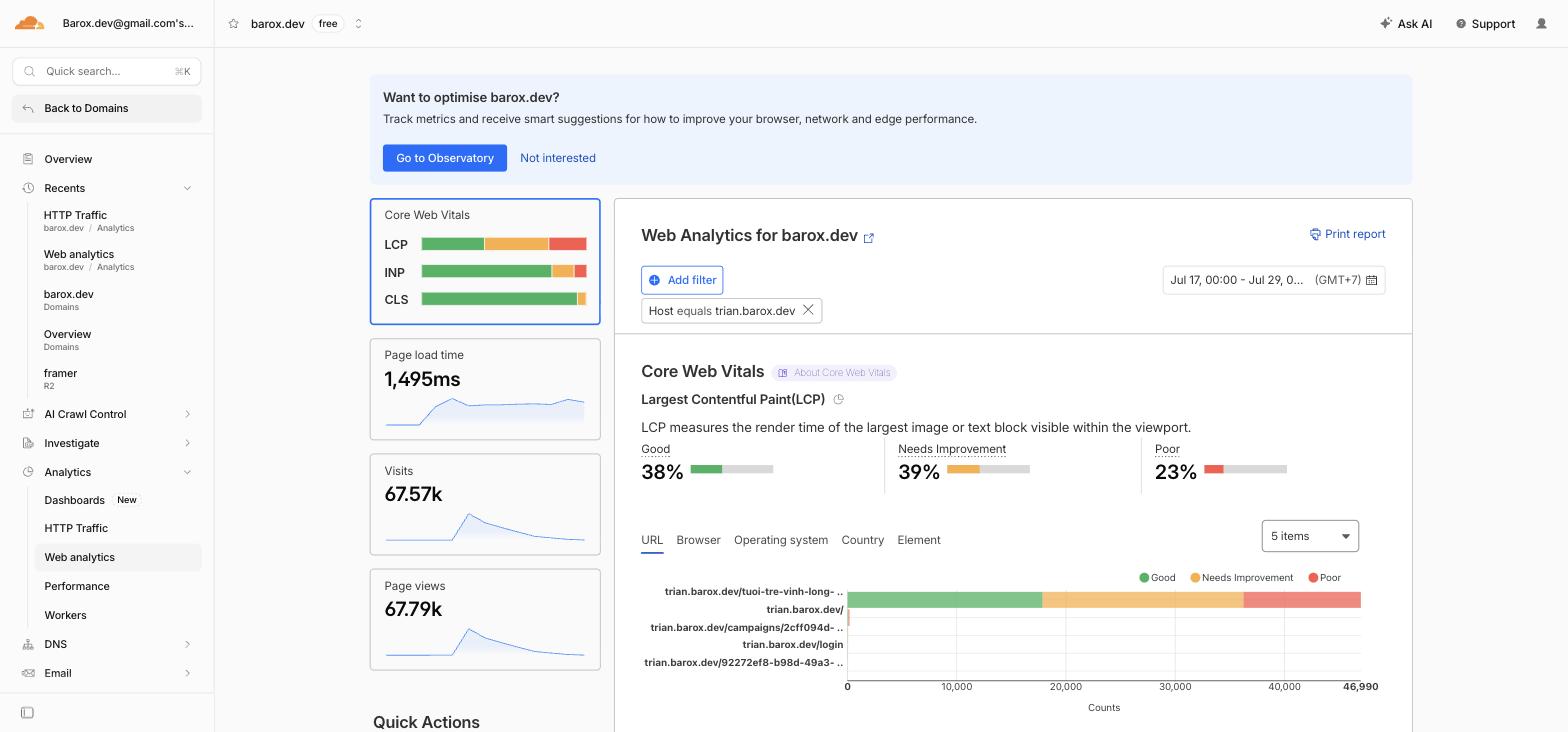
Over July 17–29, trian.barox.dev logged 67,570 visits and 67,790 page views, per Cloudflare's own Web Analytics — essentially the entire traffic of the barox.dev domain for that stretch; my own blog is a rounding error by comparison.
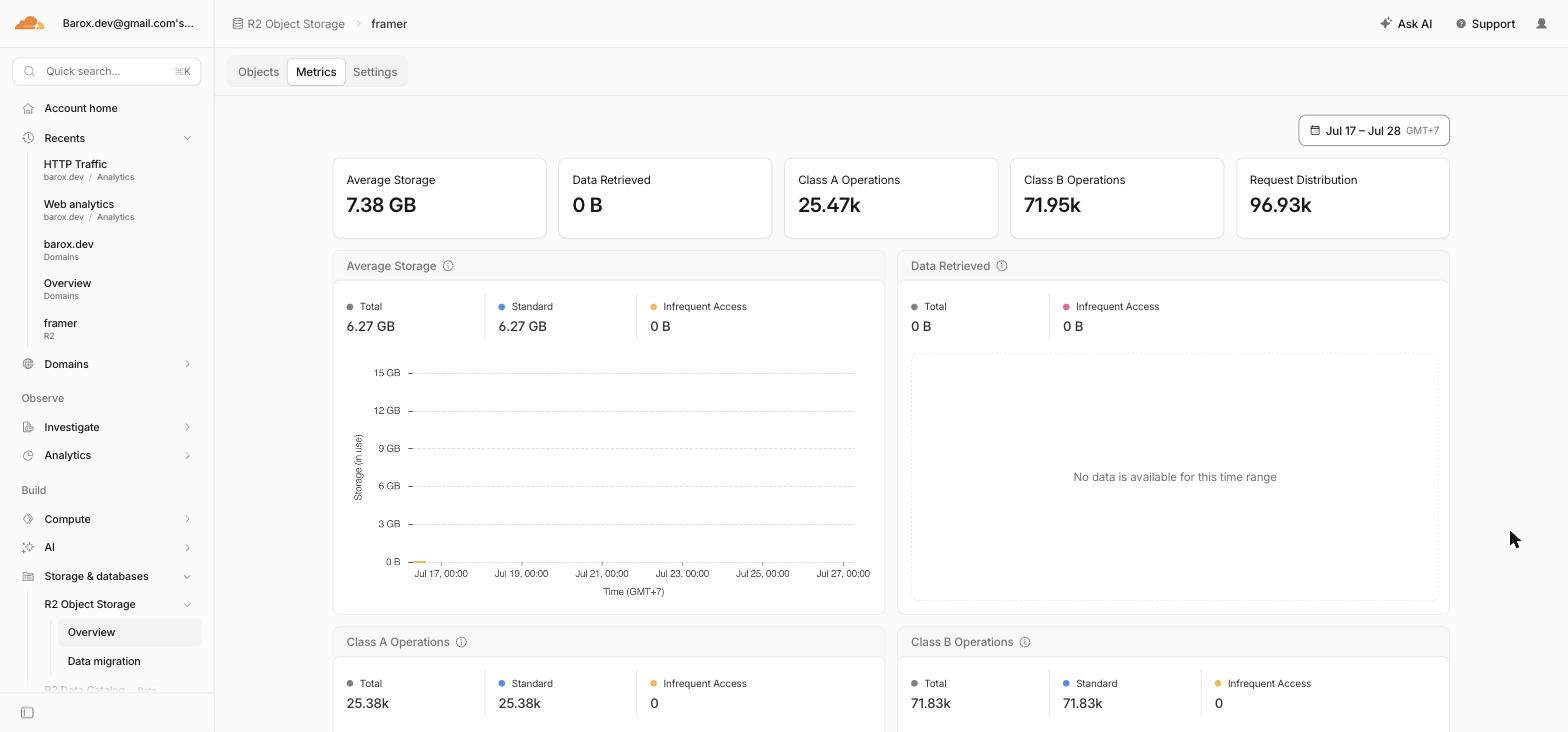
The R2 bucket holding campaign backgrounds and submissions grew from empty to 13.36 GB over the same window, averaging 7.38 GB, with 25,470 write operations and 71,950 read operations — 96,930 requests total, all of it comfortably inside R2's free tier (1M writes, 10M reads a month). "Free" isn't a marketing line in this case; it's a number that happens to be true.
I also had PostHog and GA4 running, and I'm citing neither as the primary number. GA4 caught roughly 7% of Cloudflare's visit count. PostHog caught about two-thirds. I haven't fully reconciled why — ad blockers and late instrumentation both plausibly play a part — but where sources disagree, Cloudflare is the one I trust and the one I'm citing here.
What I'd take from this
Not a tool. The constraint decides which part of the architecture needs to be expensive, and which part doesn't. No budget and non-technical users are what killed server-side image generation the first time. A repeated manual task — not a client request — is what justified a real multi-tenant backend the second time. The stack changed almost completely between the two versions. The question I asked before adding anything to it didn't.