
Nothing Happens Until You Ask

Barox
Software Engineer
I was reading through react-aria-components's source again, the <CheckboxGroup> component specifically, and ran into something I couldn't explain yet: a component I hadn't wired up at all just... works. Write <Text slot="description">Must be 8+ characters</Text> somewhere inside a <CheckboxGroup> — no id, no aria-describedby, nothing — and it's correctly linked up. Somewhere, something decided that. Where?
Isn't this just useContext?
Most of the Context I've written looks like this: one createContext, one value, read it back wherever it's needed.
const ThemeContext = createContext('light');

function App() {
  return (
    <ThemeContext.Provider value="dark">
      <Toolbar />
    </ThemeContext.Provider>
  );
}

function ThemeButton() {
  let theme = useContext(ThemeContext);
  return <button className={theme}>Save</button>;
}
That's the textbook use case — avoid prop drilling, share one piece of state with everything underneath it. useContext hands you the value, raw, and whatever you do with it is on you. It's basic state management: one shape in, same shape out.
TextContext isn't that, even though it's built from the exact same createContext/Provider/useContext primitives. Three things are different:
- It's not one value — it's a map of named buckets (
slots: {description, errorMessage}), so two different<Text>elements in the same subtree can read two different prop objects off the same context, picked by matchingprops.slotagainst a key. - It doesn't hand you the raw value — it merges it onto props you already had (
mergeProps(contextProps, props)), with your local props winning. PlainuseContextnever merges anything for you; you get the value and decide. - The thing coming out isn't the component's actual state — it's props going into a render (
<ElementType {...domProps}>), a second delivery channel alongside the props you pass directly, not the end value itself.
Keep that gap in mind, because the first guess at how it works is informed by the simpler pattern, and it's wrong for exactly the reasons above.
Here's the <CheckboxGroup> in question, from Checkbox.tsx:320-336:
<Provider
  values={[
    [CheckboxGroupStateContext, state],
    [LabelContext, {...labelProps, ref: labelRef, elementType: 'span'}],
    [TextContext, {
      slots: {
        description: descriptionProps,
        errorMessage: errorMessageProps
      }
    }],
    [FieldErrorContext, validation]
  ]}>
  {renderProps.children}
</Provider>
My first guess reading this was that Provider must be doing something clever with that slots object — matching it up against whatever's inside children, maybe walking the tree. It isn't. utils.tsx:151-161 is the entire implementation:
export function Provider({values, children}) {
  for (let [Context, value] of values) {
    children = <Context.Provider value={value}>{children}</Context.Provider>;
  }
  return children;
}
That's a loop over plain React.createContext().Provider wrappers. Sugar, so CheckboxGroup doesn't have to hand-nest four of them. It never reads children, never renders an element of its own, never touches a single prop. Delete every <Text> from inside that tree and this function wouldn't notice — it'd just keep injecting a value nobody reads.
So the wiring isn't at the provider. It's entirely on the other end.
The actual wiring is one line, in <Text>
Text.tsx:22-32 is nearly the whole component:
export const Text = /*#__PURE__*/ createHideableComponent(function Text(props, ref) {
  [props, ref] = useContextProps(props, ref, TextContext);
  let {elementType = 'span', ...domProps} = props;
  let ElementType = dom[elementType];
  return <ElementType className="react-aria-Text" {...domProps} ref={ref} />;
});
That one call is doing the real work. Everything before it in this piece — the provider wrapping, the slots object, the context itself sitting in the tree — is inert. Data, produced and handed down, waiting. This is the only place any of it turns into props a DOM element actually receives.
utils.tsx:306-362 is two hooks, not one:
export function useSlottedContext(context, slot) {
  let ctx = useContext(context);
  if (slot === null) return null; // explicit opt-out
  if (ctx && 'slots' in ctx && ctx.slots) {
    let slotKey = slot || DEFAULT_SLOT;
    if (!ctx.slots[slotKey]) {
      let availableSlots = new Intl.ListFormat().format(Object.keys(ctx.slots).map(p => `"${p}"`));
      throw new Error(`${slot ? `Invalid slot "${slot}".` : 'A slot prop is required.'} Valid slot names are ${availableSlots}.`);
    }
    return ctx.slots[slotKey];
  }
  return ctx;
}

export function useContextProps(props, ref, context) {
  let ctx = useSlottedContext(context, props.slot) || {};
  let {ref: contextRef, ...contextProps} = ctx;
  let mergedRef = useObjectRef(useMemo(() => mergeRefs(ref, contextRef), [ref, contextRef]));
  let mergedProps = mergeProps(contextProps, props);
  // (+ special-case merging for `style`, since mergeProps skips it)
  return [mergedProps, mergedRef];
}
The first hook reads whatever the provider stuffed into context, then looks up the bucket that matches the slot you passed. The second one merges that onto your own props — context first, your props second — so anything you wrote directly on the element always wins over whatever context handed down.
What happens if you forget the slot prop?
Inside this exact CheckboxGroup, it throws. The lookup falls back to a shared default bucket when you don't pass a slot — but CheckboxGroup never registered one, so the fallback comes up empty, and you get a real, listed error: "A slot prop is required. Valid slot names are "description", "errorMessage"." No silent fallback, no quiet mis-wire. Forgetting the slot is a crash, not a bug you find three renders later.
That felt like a rule of the hook until I went looking for a second example and found it isn't one.
It's not a CheckboxGroup one-off
20 components in react-aria-components provide TextContext this same way. Four of them are enough to see it's one mechanism doing different jobs, not one shape copy-pasted twenty times.
The common case shows up almost verbatim in TextField.tsx:175-179, Switch.tsx:351-355, NumberField.tsx:175-179, and TagGroup.tsx:210-214 — same {description, errorMessage} shape as CheckboxGroup. Makes sense: they're all form fields, all backed by useField underneath.
But Dialog.tsx:189-197 does something CheckboxGroup doesn't:
[TextContext, {
  slots: {
    [DEFAULT_SLOT]: {},
    description: contentProps
  }
}]
Dialog registers that default bucket too — just as an empty object. A <Text> with no slot inside a Dialog doesn't throw at all; it renders plain, because the lookup finds something sitting in that bucket instead of nothing. Add slot="description" and it still gets the real props, wired to the dialog's own aria-describedby. So the crash-on-forgetting behavior wasn't a rule the hook enforces — it's a choice each component makes, by registering a default bucket or leaving it out.
Select.tsx:421 goes further and uses the same context to do the opposite of handing props down:
{/* clear description and error message slots */}
<TextContext.Provider value={undefined}>{renderProps.children}</TextContext.Provider>
No slots map at all here — it just resets the context straight back to undefined, inside the bit that renders the trigger's current selection. The comment in the source says why: the field's own description and error-message slots were registered higher up the tree, and without this reset, anything rendered inside the selected item would quietly inherit the field's description instead of having none of its own. Same context, used as a fence instead of a pipe.
And RadioGroup registers this context twice, at two different nesting levels, with two different shapes. The group itself, at line 323-327, gets both a description and an error message — a group can be invalid as a whole. Each individual radio inside it, at line 445-450, only gets a description — no error message, because a single radio doesn't carry its own validation state, only the group does. The slots map was never a schema the context defines once. It's just whatever shape that particular hook call happened to return, redeclared fresh at whichever level owns it.
Where descriptionProps comes from in the first place
One more hop down, to confirm this bottoms out where React Aria Refuses to Render Anything already found buttonProps bottoming out. useCheckboxGroup.ts:63:
let {labelProps, fieldProps, descriptionProps, errorMessageProps} = useField({...});descriptionProps is just {id: <generated id>}, produced by react-aria's useField hook — the same "behavior layer returns a prop object, no DOM opinion" contract as useButton. react-aria-components doesn't invent the id-linking logic here either. It takes the object react-aria already computed and threads it through context instead of handing it to you as a direct prop.
Here's the whole chain end to end:
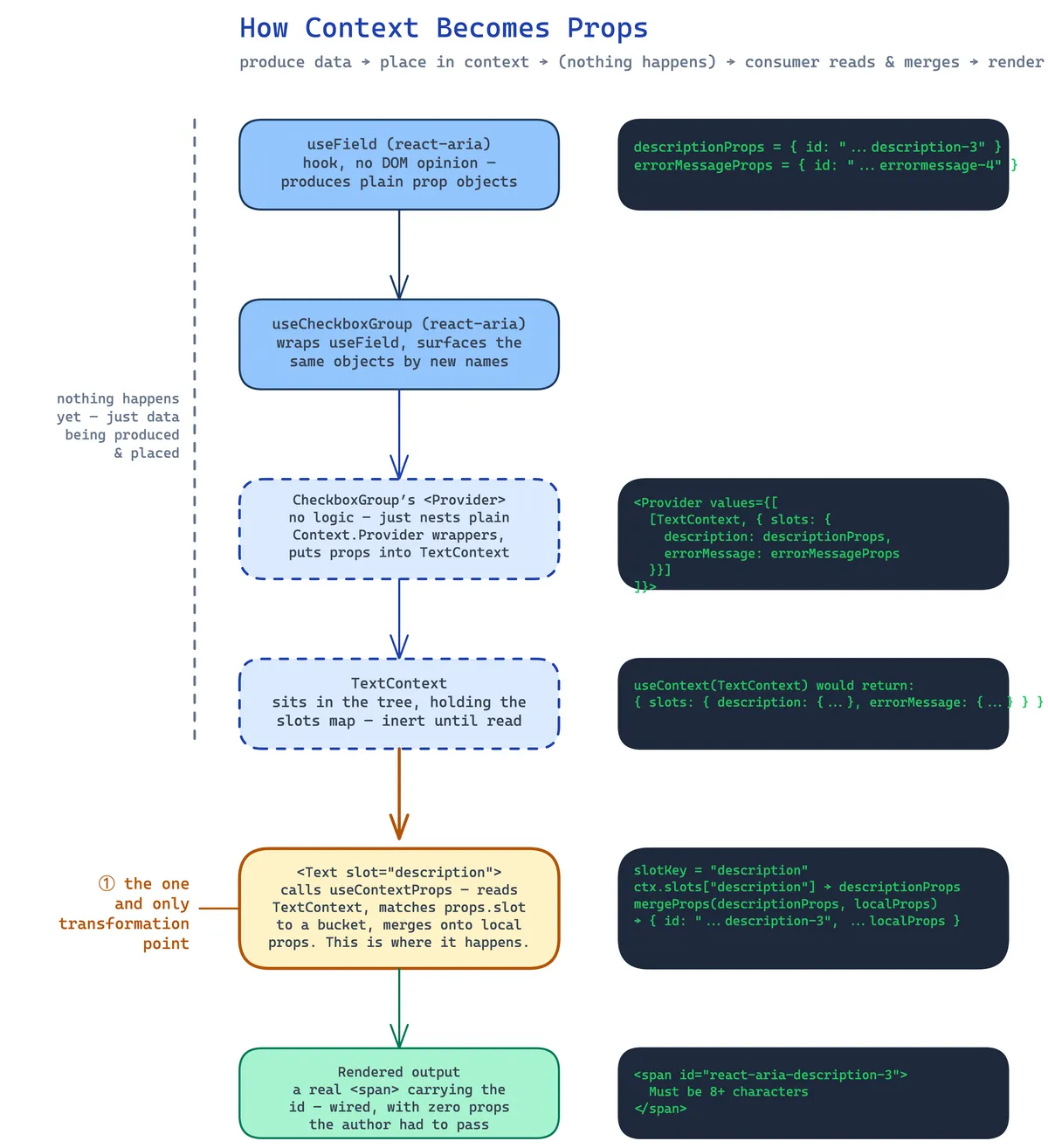
The diagram's point is the gap between step 4 and step 5. Everything up to TextContext is just data sitting in the tree, inert, regardless of how many providers it passed through to get there. The transformation — context becoming an actual prop on an actual element — happens exactly once, at whichever useContextProps call bothers to ask for it. No consumer, no wiring, no matter how many Providers wrap the tree above it.
Next time something "just works" off a context value with no props passed explicitly, go find the useContext call actually reading it — that's where the behavior lives, not wherever the value got set.